Thursday, November 12, 2015

Germany – Blog #6

The one thing that I found most intriguing in this reading was the fact that the Germany population showed so little support for the government, but it really comes as no surprise with all things considered.  As a result of the First World War, Germany was ordered in the Treaty of Versailles to pay large reparations to the allied forces, and the book says that the consequences the treaty left Germans feeling that the terms of were unjust for a country that was essentially in debt.   Despite the debt or the financial condition of the country, I can see how the German population would point the blame of the terms on the shoulders of the government that agreed to it, the Weimar Republic (pg. 204).  The democracy was formed during the war so naturally when things started to spiral out of control, the people of Germany continued to point the blame on the Government which is similar to what happened here in the states with the economic recession. 

The Treaty of Versailles resulted in very harsh consequences of the First World War for Germany that would end up resulting in terrible conditions for the country through widespread ecnomic struggles and hunger 

In the coming years after the war, Germany made the decision to not pay the reparations that were agreed upon in the Treaty of Versailles.  As a result, France took action in the form of collecting what was owed to them through coal that was mined within German borders.  This ended up resulting in skyrocketing inflation when the labor unions went on strike and money was printed to pay for foreign coal to be imported.   Of course again, and rightfully so, the inflation, widespread hunger and hard times that were brought on the people were as a result of a decision made by the government.  In a time like this, logically it would be very difficult to continue to show support for the government when that have worsened living conditions and lost the confidence of the people.

Later, with the crash of the New York stock market, capital in Germany dried up and the unemployment rate skyrocket from 7% to 31% in a matter of three years.  Industrial production was cut in half as a result of the crisis and lack of exported goods.  Again, this resulted in inflation and an increase in the tax rate to even the wealth distribution and left further doubt in the weak Weimar Republic.  At this time, I can imagine that Germans also put lots of blame on the people and government of France as well as the United States who seemingly worsened their situation with the crash of the market. 

As Hitler gained power through his calculated moves to gain support, but with the sole purpose of creating world dominance, it was interesting to see how quickly it faded – just as it did with other politicians – as the war turned in favor of the allies.   Like those before him, he was able to build his popularity through promises and his ability as an effective speaker, but it deteriorated quickly when things again were not working in favor of the German people.  By the time the war ended, it was devastating for the German population to see that Hitler was going to continue with such determination until there was essentially nothing left.  On page 285, it says that Hitler would fight until the very end because to quit would just show that they were weaker than the allied forces.  I found this reasoning to be absolutely incredible and heartless.  This determination for his goal could only have shown Germans how much he cared about them. 
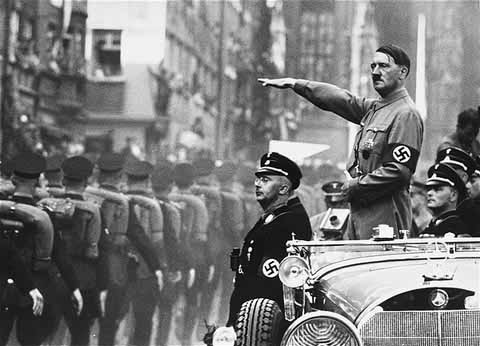
Adolf Hitler, leader of the Nazi party through WWII, maintained one of the most aggressive strategies of expanding the borders of Germany and was the key source of blame for the widespread loss of life.  Even with the support of the German population lost, he pushed on with is goals of world domination.


After all that the German people had gone through in 25 years, it’s hard to even fathom what your mindset would be.  In this time you had gone through two wars resulting in catastrophic death through Europe, and in the middle had been put through absolutely miserable living conditions.  Once the war was over, you then had to worry about cleaning up the mess that was left behind as much of Germany was in unlivable ruins as a result of the war and bombings from the allied forces.  In a time like this you would have to have little feeling of national pride and probably embarrassment for the actions of your government.  The massive amount of life that was lost and the damage that was done is nearly incomprehensible.  To try to put it in perspective is difficult, and when Professor Wolf mentioned that the people of Germany embrace their history, it is difficult as an American to grasp this.  This sort of widespread destruction is something that many people would probably try to put behind them.  I can definitely say that I’m interested to see and experience some of these different feelings and emotions in the coming weeks and what kind of lingering effects this has on Germany.

Berlin in 1945 in ruins as a result of WWII and the bombings by the allies.

Thursday, October 22, 2015

Germany – Blog #5 - The Development of a Modern German Nation

Despite being a relatively young country, Germany has a quite long and tumultuous road of history.  Before finally unifying in 1871, Germany subjected itself to a great deal of strife among its neighbors and even bouts of civil war between kingdoms lying within its borders.  After years of fighting and constant changing hands of land, the people of Germany, along with pressure from outside the country, pushed them to an increased sense of nationalism and forced their need for unification.

In this long road to unification, one of the largest powers in Germany was Prussia, which put a strong emphasis on the power of their military.  With the crowning of Prince Elector Frederick III and being centrally located in Europe, Prussia armed itself heavily as it was vulnerable to attacks on most of its borders in a fight for control of central Europe.  As the book states on pg. 79, and a theme that carried on for two centuries, winning was essential for the fact that there was the expectation that the payment of reparations, or land, would be forced on the loser. So, while it was the tenth largest in size and thirteenth in population, Prussia maintained the third or fourth largest military in Europe.  Consequently, Prussia did the task of occupying many European forces as Britain controlled the seas during the colonization of America.

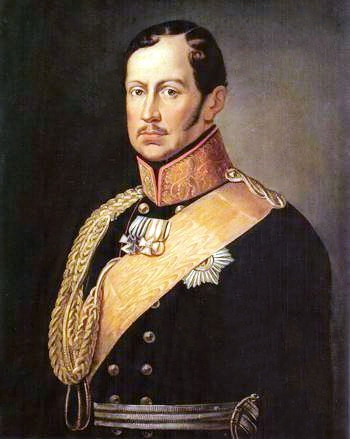
Price Frederick William III of Prussia who helped to develop a strong military 

While Prussia maintained a bulk of the power during this time, Germany was building both within its borders and beyond, as according to pg. 89 in the text, “the nation grew, in fact, precisely because of its fragmented identity and the practical requirements of a multitude of small states and governments.”  The expansion of these territories came about through a need for education and understanding of law and public finance and the “educational elite” of were pulled from both the lesser aristocracy and the middle class to represent a wider span of the population.  Many of the conflicts and unrest that arose during this time were a result of economic struggles and poor farming seasons and resulted in high food prices, the kind of events that called for cooperation and partnership between kingdoms.   The power of Prussia would eventually be met in 1806 by Napoleon Bonaparte who received a strong welcoming in his march on Berlin.  Prussia however, did not join the resulting Confederation of the Rhine, and sought to overcome their defeats by Napoleon and regain their control.

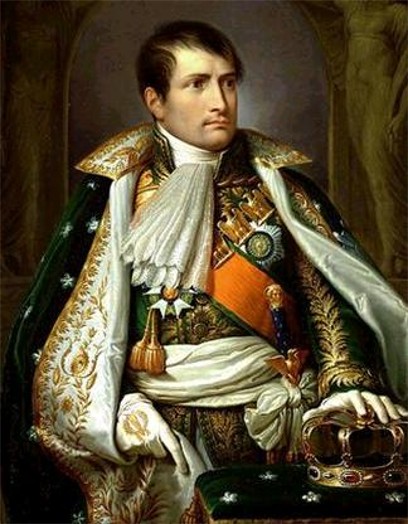
Napoleon Bonaparte, who would prove to be one of Germany's greatest challengers in their movement toward unification

France became a major hatred for the people within German borders and as writer Ernst Moritz Arndt said, “Let unanimity be your church! Make the hatred of the French your religion, and let freedom and fatherland be the saints to whom you pray!” (pg. 105).  This thought and others formed a nationalistic movement and a shift was seen in Germany when they learned of the defeat of Napoleon in Russia and a call to arms in 1813.  With the allied forces of Russia, England, Prussia, Sweden, and eventually Austria, Napoleon finally stood down outside of Paris.  Life in Germany changed and hopes for a unification and constitution grew in response to this victory. 

German nationalism would be challenged again in 1840 by the French as they made efforts to expand their borders, but after a protest on the German Confederation for a lack of action, nationalism grew once again.   In 1848, an assembly of 585 officials met at St. Paul’s Church in Frankfurt that guaranteed a list of freedoms and to elect a national government.  The challenge that came about was what regions would be included in the new Germany.  Would it be a “Great Germany” or a “Small Germany?”  The difference between the two would be the inclusion of the Austrian lands and the emperor who would rule.  As the debate went on, southwest Germany was fighting for a democracy and revolt sprung out. 

St. Paul's Church in Frankfort was the meeting place of 585 representatives who developed a list of freedoms and elected a national government in 1848.

The period of 1848-1871 saw in increase in the economies by the growth of the rail system in Germany and from 1850 to 1857 the size of money in circulation tripled through the unified economy that resulted.  The growth within the area resulted in a decrease in unemployment and the rail system helped to quiet the hunger revolts that had been seen prior to the expansion of the rail system.  This increase in industrialization helped to bring together German society and populations grew significantly in rural and industrial epicenters across Germany and around Berlin. 


A battle once again broke out, this time between Prussia and Austria as Prussia allied with Italy and then declared that the constitution was not applicable and declared it void.  As a result, Southern Germany joined forces with Austria and thus the battle between Prussian and Austria became a fight between northern and southern Germany and resulted in the Treaty of Prague that removed Austria from Germany.  The end result was the conclusion of the Germany Confederation and a Prussia-dominated confederation that eventually joined with the southern states of the Main River through a military agreement.  Unification then became a necessity for Germany’s ability to remain strong to outside pressures and one final war with France in 1870 ended in a truce in January of 1871 and shortly thereafter followed the Treaty of Frankfurt.  The political unification of Germany and the battles fought created a stronger sense of patriotism among Germany and the bridge between the southern states and the Northern German Confederation was built.

The Treaty of Frankfurt put an end to the Franco-Prussian war and lead to the further unification of Northern and Southern Germany.

Saturday, September 12, 2015

History of Berlin


Germany – Blog #4

The Berlin Wall, which stood from 1961 until 1989, was a means
of separating communist East Berlin, from the fascist Western
Berlin and negatively impacted many citizens.
I would say that it is safe to venture to say, that many Americans are not very well versed in the history of Germany, let alone Berlin.  For myself, I certainly fall into that group of people.  Prior to getting just a two hour snapshot into the history of Berlin, I knew only what most people know, and that is the basic knowledge of the once-existent Berlin Wall.  I had always associated the other major German history with Germany alone, and not made connections to Berlin. Of course most people know the general purpose of the wall – separating East Berlin from West Berlin – of preventing the spread of the ideas present in West Berlin to the now communist, East Berlin.  Many people are unaware, and may not even consider the consequences of constructing a wall in the middle of one of the largest cities in Europe.  In doing this, East Berlin successfully kept out fascist ideas that were present in Western Germany, but also effectively separated families from themselves and the strict enforcement of the wall made it nearly impossible to communicate around the barrier.

I also found the construction of and rebuilding of Berlin to be very interesting.  I am pretty well traveled across the United States with much thanks to my parents for taking us to historical places growing up, and have always been intrigued by the differences in architecture and their time periods because it tells a story.  Some of this also comes from being raised in a house that was built in the 1850’s as well and being a part of many renovations in the house I grew up in to return it to a more time-period correct state.  Nonetheless, it was also interesting hearing about Hitler’s plans for building up Berlin and his goals of holding an annual Olympic Games based on the success of the 1936 games.  Also, with all the history that Germany has, it was interesting to hear that there was a modernistic movement before the Nazi takeover.  This time period ended up being short-lived, and with the entrance of the Nazi regime meant the return of more classic architectural designs.  The Nazi party also built an airport in anticipation of increased flights in and out of Berlin.  I also appreciated during a race of new construction, both East Germany and West Germany were recycling the once torn down buildings to rebuild new buildings or by building a hill that eventually became the home of buildings built on top of it.  I thought it was also fascinating to hear how both construction and demolition of buildings in Berlin are both politically and emotionally charged due to the competition and tension between East and West Berlin as well as the cycle of building, and rebuilding that happened between the destruction that occurred between World War I and World War II. 

One thing that I noticed about the documentary, when especially focusing on the people of East Berlin, is that they are very nostalgic of the past and have a very opinionated view.  I found it especially interesting to see that two different people of East Berlin had two very different outlooks on the possibility of rebuilding the Berliner Schloss after the palace built in its place was demolished in the 2000’s after the wall had come down.  It just goes to show that people are going to interpret things differently given the situation, and just because you feel that something is right, there are surely going to be others that have a very different opinion of the situation.  I was also unaware that Berlin had opened its doors to others who had been persecuted throughout Europe in the 17th Century.  Then, a few hundred years later, the Jews who were once welcomed, became the focal point of a racial purification in the city they were once welcomed to before.  During this time, they faced the brutal treatment that has been storied for many years, as well as vandalism of their businesses and a countless number of rapes among Jewish females.  It goes without saying, that this was one of the darkest times in the history of Berlin.  I feel like this documentary has really helped to make some more connections with Berlin and the history of Germany as a country, and I am looking forward to furthering that in just a few short months.
The original Berliner Schloss, which was damaged during
World War II by bombing by the Allied Forces, was replaced
with the Palace of the Republic in 1964 which has since been
demolished.  A new Berliner Schloss is currently being built on the
same original grounds and is expected to be completed in 2019.

Tuesday, September 8, 2015

Luther, the Emancipator

I knew very little about Martin Luther prior to watching the video, but wow, this man was the martyr that never was.  In that, I mean that he did so many things that resisted the power of the Church in an effort to be the symbol of the common man.  Here is a man that was so determined in his beliefs that he knowingly faced what he expected to be a certain charge of heresy resulting in death when he went to face the pope.  In this “jury” he was given the opportunity to recant all that he had written about the Catholic Church and their contradictions, and he refused because he stood firm in his belief that he was right and that the Church was wrong.  One of the contradictions that Luther focused on was the practice of the 7 sacraments, which Luther insisted 5 of which were created by the Church as only two existed in the Bible.  

Martin Luther authored the 95 Theses, and as the story goes,
attached it to door of the All Saints' Church in Wittenberg.
Luther was clearly a very strong-minded individual and played a role in Germany that proved to be very pivotal in acting as a representation of the people of Germany and their effort to stand up to the Roman Empire, the Catholic Church, and for the freedoms as individuals to worship as they wish and not through the Church.  This man, who authored the “95 Theses,” started what would become the German Revolution, as well as playing a part in the Protestant Reformation, and had a great impact on all of Europe and eventually the America which was founded on religious freedom.  At a time that the Church held such great power, it comes as no surprise to me that the Church took his actions very seriously.  After all, the Church and politics were essentially the same body at this time, so to lose control in the church, meant a loss of control in government and the empire.   

Unknowingly to Luther, he had turned himself into a very likable man by pointing out all the flaws in the Catholic Church and exposing the use of the taxes that were funding the Roman Empire and the Church.  Luther was a very wise and witty man with his exploitations of the Church and refused to be slowed by the authority that it held.  In a time when communication was obviously difficult, Luther took advantage of the latest advances in technology by spreading his beliefs through the use of the printing press and translating the bible into German.  The use of the printing press gave the German-speaking population the opportunity to follow the word of god through the bible and not through the message sent by the Church. It seems as though his use of sarcasm and humor in his message played into the hearts of Germans and other Europeans as it spread like wildfire. 

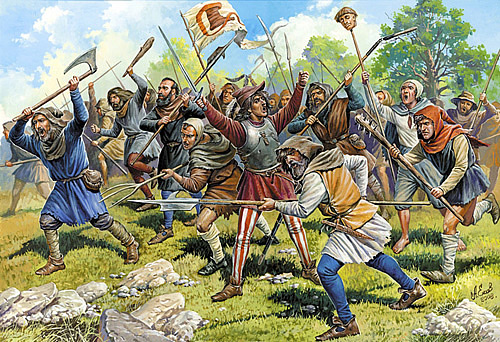
Luther's message became so strong that groups of peasants traslated the freedom of
faith to a freedom from social constraints.  Eventually this lead to a brief war that
resulted in the death of more than 100,000 rebel peasants.


Eventually, and again without prediction, Luther’s message gained so much power that it developed into a revolution among the peasants and resulted in a slaughter directed by Luther.  Luther attested that work was the primary duty on earth and thus equated the peasants to the devil and the Catholic Church.  Regardless of his intent, Luther had turned Europe into a religiously diverse territory and as the video said, became one of the greatest emancipators in history.  

Wednesday, September 2, 2015

Germany - Blog #2 - German Renaissance

I found a few things interesting in the Chapter 2 readings, one of which was the Imperial Diet at Augsburg in 1555 that established the beliefs of the empire as those of the ruler.  What I found intriguing about the German Renaissance in contrast to America today, is that it is similar to Christianity being the dominant religion in the United States.  Of course, here in the U.S., religion is left up to the individual and there is a defined separation between the church and state.  In today’s day in age, it would be considered entirely unacceptable if this scenario were to happen in America, but with the structure of our government and current beliefs within society, it is not something that could even be considered feasible.  In fact, you can see in recent years that the government appears to be separating itself even further from religious issues evident in the recent arguments about the use of “god” in the Pledge of Allegiance and by removing religion from other pieces of the government so as to not show a preference toward any one religion.  I found that the freedom to choose your religion by relocating under what the book defined as, ius emigrandi, to be obviously very different from what the norms are now in the western world for the obvious reason that people are granted the freedom to worship as they choose.  However, for this same reason, you could also argue that the two are very similar as the United States and many other countries, in granting the freedom to worship based on your own personal beliefs.

 Depicted here is the negotiations of the Peace of Augsburg which not only established the Lutheran states of the empire, but also allowed, ius emigrandi, or the ability to emigrate to another region that aligned with your religious beliefs.

At the same time that this was happening in Europe, the teachings of John Calvin and Calvinism were rather intriguing as it is similar to the battle that the United States is having in the Middle East.  Much of the conflict over there, and around the rest of the world through acts of terror, are being driven by religious beliefs and extremists who are jeopardizing the religious freedoms that others around the world are enjoying.  

John Calvin, teacher of Calvinism, proscribed that beliefs of the population should be personal and not those of the state.

A return of Calvinistic belief is what you expect to see in a country like the U.S. if a national religion were to be adopted as this country has been built on diversity over the past 50 years.  With the current social and religious standards in America, it would obviously be extreme if a group were to begin a civil war over religious beliefs within the borders of the United States, but that is easily assumed because of the demographic of the population and the ideals of freedom that the country has been built on.  People come to the United States as a way of escaping religious persecution or strife, so coming to the U.S. and causing conflict is not entirely likely.

Through the chapter reading, and through my own German heritage, it is evident to me that German’s have a strong belief system and a unified structure of dealing with important matters.   I find that this is also evident in Europe today in the European Union and their governing body.  Through Parliament, the EU uses a unified approach that is designed to be operated with all the member countries in mind, and while this has not been entirely successful recently with the downtown in the European markets, it is certainly the current trend in much of the world today with a concentration on equality.

Friday, June 5, 2015

Germany – Blog #1

When I decided that I was going to return to school to finish my degree, I had never put any consideration into studying abroad.  I thought of it as something that many people did to get work experience and that was something I felt I already had since I had been in a management position for several years.  What really turned me on to the idea was when I took International Business with Professor Moussetis.  Never before had I really considered the cultural side of it that Professor Moussetis explained in class.  As the leader of the Greece trips and realizing that he was the one that my mother traveled with when she returned to school several years back, I thought that I might give this a shot.  He did a great job during the course of conveying how it was an important experience to do while you were young and had the time because the opportunity may disappear when you got to your full time career. 

So, initially that was the trip I wanted to go on.  I liked the style and approach of the course that Professor Moussetis had and thought it was perfect for me.  After much deliberation, and some procrastination, the Greece grip filled up.  Looking back, it was probably the best thing that could have happened, after all, I’m not Greek.   So after looking into other options, that is when I really considered doing the Germany trip.  I met with Professor Wolf briefly during winter term and did my own “interview” of him.  Right away I could see his passion and knowledge for Germany and its history.  We also share a love for baseball, so instantly I knew that I was going to go for it.  Also, the fact that I am part German made this trip very intriguing to me.  Being from so many different backgrounds, growing up we never really did discuss or celebrate our heritage.  I always just thought of myself as an American, but not an American in the sense that you are a citizen of the country.  I was an American in the sense that American meant that it was your historical background because I really knew nothing else.  Like everyone, I’ve studied some of the Germany’s past in history classes back in high school, but it was really only at surface level because obviously we never got to experience it first-hand IN Germany.

Like Andy mentioned, I am also interested in the Christmas market because I would probably label myself as a bit of a beer snob.  Rarely will you find me with a can of one of those “light/lite” beers in my hand.  I’m not a big drinker, but would classify myself as the social drinker.  So when I do have a beer, I like it to be something that I can enjoy for what it is or to complement a meal.   I’m also a huge winter sport fan being a snowboarder, and love to take my dog on walks through the forest preserve or sit around the bonfire in the winter with a cold beer and just hang out with friends and family.  The cold is really not anything that has bothered me.  I’ve been to many different beer gardens, but never have I had the experience of a beer garden in the middle of December.  I feel like seeing a large group of people doing this, I will fit right in and it should be a great experience of great German food and drinks.


Another part of the trip that I look forward to seeing is the seeing the great amount of European and German architecture.  The house that I grew up in was built in the 1850’s and my parents always tried to impart on me an appreciation for history and architecture, and we sort of lived that by maintaining a lot of the history of the house by keeping the interior very time period correct.  Growing up we would travel to many historical places and visit famous residences around the country for their historic qualities, places like the Biltmore Mansion and southern plantation homes.  Those trips really gave me a greater understanding of the history of America that many people don’t see.  Of course, for the most part, we are limited to the just few hundred years of architectural history in the United States, so seeing something several hundred years older will be outstanding.


I expect to learn, most importantly, the different culture and the different mindsets of people outside the United States.  As Professor Wolf mentioned, noticing how people respond to talking to someone who is foreign to that country and what they think of you and your ideals and beliefs.  We’re able to do that so easily here, but as someone that has never traveled outside the country, it is something that I have never experienced from the other side of the conversation. 
So, yes, the trip most certainly does fulfill a requirement for my program, but it also will have some great value to me because I will get to make some connections to my own story and also experience so many things that I haven’t been able to in America.  I am really looking forward to the trip and discovering a different culture and what I might take away from it.

894 words