Germany –
Blog #6
The one
thing that I found most intriguing in this reading was the fact that the
Germany population showed so little support for the government, but it really comes as no surprise with all things considered. As a result of the First World War, Germany
was ordered in the Treaty of Versailles to pay large reparations to the allied
forces, and the book says that the consequences the treaty left Germans feeling
that the terms of were unjust for a country that was essentially in debt. Despite the debt or the financial condition
of the country, I can see how the German population would point the blame of
the terms on the shoulders of the government that agreed to it, the Weimar
Republic (pg. 204). The democracy was
formed during the war so naturally when things started to spiral out of
control, the people of Germany continued to point the blame on the Government
which is similar to what happened here in the states with the economic
recession.
 |
| The Treaty of Versailles resulted in very harsh consequences of the First World War for Germany that would end up resulting in terrible conditions for the country through widespread ecnomic struggles and hunger |
In the
coming years after the war, Germany made the decision to not pay the
reparations that were agreed upon in the Treaty of Versailles. As a result, France took action in the form
of collecting what was owed to them through coal that was mined within German
borders. This ended up resulting in skyrocketing
inflation when the labor unions went on strike and money was printed to pay for
foreign coal to be imported. Of course
again, and rightfully so, the inflation, widespread hunger and hard times that
were brought on the people were as a result of a decision made by the
government. In a time like this,
logically it would be very difficult to continue to show support for the
government when that have worsened living conditions and lost the confidence of
the people.
Later, with
the crash of the New York stock market, capital in Germany dried up and the
unemployment rate skyrocket from 7% to 31% in a matter of three years. Industrial production was cut in half as a
result of the crisis and lack of exported goods. Again, this resulted in inflation and an
increase in the tax rate to even the wealth distribution and left further doubt
in the weak Weimar Republic. At this
time, I can imagine that Germans also put lots of blame on the people and
government of France as well as the United States who seemingly worsened their
situation with the crash of the market.
As Hitler
gained power through his calculated moves to gain support, but with the sole
purpose of creating world dominance, it was interesting to see how quickly it faded
– just as it did with other politicians – as the war turned in favor of the
allies. Like those before him, he was
able to build his popularity through promises and his ability as an effective
speaker, but it deteriorated quickly when things again were not working in
favor of the German people. By the time
the war ended, it was devastating for the German population to see that Hitler
was going to continue with such determination until there was essentially
nothing left. On page 285, it says that
Hitler would fight until the very end because to quit would just show that they
were weaker than the allied forces. I
found this reasoning to be absolutely incredible and heartless. This determination for his goal could only
have shown Germans how much he cared about them.
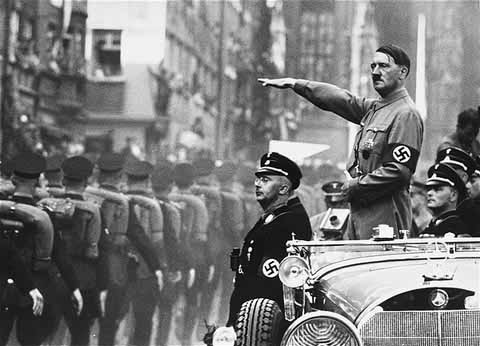 |
| Adolf Hitler, leader of the Nazi party through WWII, maintained one of the most aggressive strategies of expanding the borders of Germany and was the key source of blame for the widespread loss of life. Even with the support of the German population lost, he pushed on with is goals of world domination. |
After all
that the German people had gone through in 25 years, it’s hard to even fathom
what your mindset would be. In this time
you had gone through two wars resulting in catastrophic death through Europe,
and in the middle had been put through absolutely miserable living
conditions. Once the war was over, you
then had to worry about cleaning up the mess that was left behind as much of
Germany was in unlivable ruins as a result of the war and bombings from the
allied forces. In a time like this you
would have to have little feeling of national pride and probably embarrassment
for the actions of your government. The
massive amount of life that was lost and the damage that was done is nearly
incomprehensible. To try to put it in
perspective is difficult, and when Professor Wolf mentioned that the people of
Germany embrace their history, it is difficult as an American to grasp
this. This sort of widespread
destruction is something that many people would probably try to put behind
them. I can definitely say that I’m
interested to see and experience some of these different feelings and emotions
in the coming weeks and what kind of lingering effects this has on Germany.
 |
| Berlin in 1945 in ruins as a result of WWII and the bombings by the allies. |

No comments:
Post a Comment