Germany – Blog #5 - The Development of a Modern German Nation
Despite being a relatively young country, Germany has a
quite long and tumultuous road of history.
Before finally unifying in 1871, Germany subjected itself to a great
deal of strife among its neighbors and even bouts of civil war between kingdoms
lying within its borders. After years of
fighting and constant changing hands of land, the people of Germany, along with
pressure from outside the country, pushed them to an increased sense of
nationalism and forced their need for unification.
In this long road to unification, one of the largest powers
in Germany was Prussia, which put a strong emphasis on the power of their
military. With the crowning of Prince
Elector Frederick III and being centrally located in Europe, Prussia armed itself
heavily as it was vulnerable to attacks on most of its borders in a fight for
control of central Europe. As the book
states on pg. 79, and a theme that carried on for two centuries, winning was
essential for the fact that there was the expectation that the payment of
reparations, or land, would be forced on the loser. So, while it was the tenth
largest in size and thirteenth in population, Prussia maintained the third or
fourth largest military in Europe.
Consequently, Prussia did the task of occupying many European forces as
Britain controlled the seas during the colonization of America.
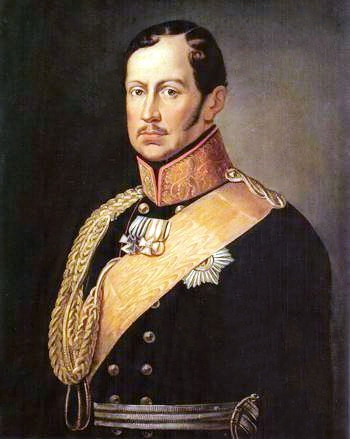 |
| Price Frederick William III of Prussia who helped to develop a strong military |
While Prussia maintained a bulk of the power during this
time, Germany was building both within its borders and beyond, as according to
pg. 89 in the text, “the nation grew, in fact, precisely because of its
fragmented identity and the practical requirements of a multitude of small
states and governments.” The expansion
of these territories came about through a need for education and understanding
of law and public finance and the “educational elite” of were pulled from both
the lesser aristocracy and the middle class to represent a wider span of the
population. Many of the conflicts and
unrest that arose during this time were a result of economic struggles and poor
farming seasons and resulted in high food prices, the kind of events that
called for cooperation and partnership between kingdoms. The power of Prussia would eventually be met
in 1806 by Napoleon Bonaparte who received a strong welcoming in his march on
Berlin. Prussia however, did not join
the resulting Confederation of the Rhine, and sought to overcome their defeats
by Napoleon and regain their control.
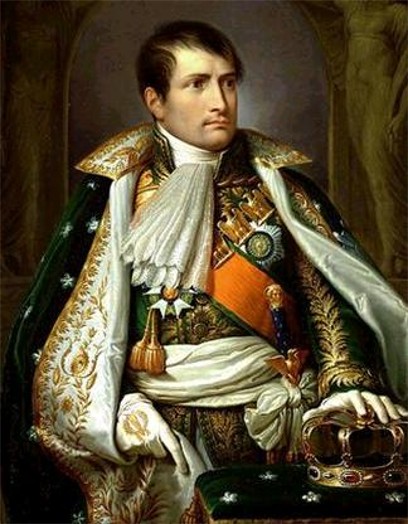 |
| Napoleon Bonaparte, who would prove to be one of Germany's greatest challengers in their movement toward unification |
France became a major hatred for the people within German
borders and as writer Ernst Moritz Arndt said, “Let unanimity be your church!
Make the hatred of the French your religion, and let freedom and fatherland be
the saints to whom you pray!” (pg. 105).
This thought and others formed a nationalistic movement and a shift was
seen in Germany when they learned of the defeat of Napoleon in Russia and a
call to arms in 1813. With the allied
forces of Russia, England, Prussia, Sweden, and eventually Austria, Napoleon
finally stood down outside of Paris.
Life in Germany changed and hopes for a unification and constitution
grew in response to this victory.
German nationalism would be challenged again in 1840 by the
French as they made efforts to expand their borders, but after a protest on the
German Confederation for a lack of action, nationalism grew once again. In 1848, an assembly of 585 officials met at
St. Paul’s Church in Frankfurt that guaranteed a list of freedoms and to elect
a national government. The challenge that
came about was what regions would be included in the new Germany. Would it be a “Great Germany” or a “Small
Germany?” The difference between the two
would be the inclusion of the Austrian lands and the emperor who would
rule. As the debate went on, southwest
Germany was fighting for a democracy and revolt sprung out.
 |
| St. Paul's Church in Frankfort was the meeting place of 585 representatives who developed a list of freedoms and elected a national government in 1848. |
The period of 1848-1871 saw in increase in the economies by
the growth of the rail system in Germany and from 1850 to 1857 the size of
money in circulation tripled through the unified economy that resulted. The growth within the area resulted in a
decrease in unemployment and the rail system helped to quiet the hunger revolts
that had been seen prior to the expansion of the rail system. This increase in industrialization helped to
bring together German society and populations grew significantly in rural and
industrial epicenters across Germany and around Berlin.
A battle once again broke out, this time between Prussia and
Austria as Prussia allied with Italy and then declared that the constitution
was not applicable and declared it void.
As a result, Southern Germany joined forces with Austria and thus the
battle between Prussian and Austria became a fight between northern and
southern Germany and resulted in the Treaty of Prague that removed Austria from
Germany. The end result was the
conclusion of the Germany Confederation and a Prussia-dominated confederation
that eventually joined with the southern states of the Main River through a
military agreement. Unification then
became a necessity for Germany’s ability to remain strong to outside pressures
and one final war with France in 1870 ended in a truce in January of 1871 and
shortly thereafter followed the Treaty of Frankfurt. The political unification of Germany and the
battles fought created a stronger sense of patriotism among Germany and the
bridge between the southern states and the Northern German Confederation was
built.
 |
The Treaty of Frankfurt put an end to the Franco-Prussian war and lead to the further unification of Northern and Southern Germany.
|

No comments:
Post a Comment