Saturday, September 12, 2015

History of Berlin


Germany – Blog #4

The Berlin Wall, which stood from 1961 until 1989, was a means
of separating communist East Berlin, from the fascist Western
Berlin and negatively impacted many citizens.
I would say that it is safe to venture to say, that many Americans are not very well versed in the history of Germany, let alone Berlin.  For myself, I certainly fall into that group of people.  Prior to getting just a two hour snapshot into the history of Berlin, I knew only what most people know, and that is the basic knowledge of the once-existent Berlin Wall.  I had always associated the other major German history with Germany alone, and not made connections to Berlin. Of course most people know the general purpose of the wall – separating East Berlin from West Berlin – of preventing the spread of the ideas present in West Berlin to the now communist, East Berlin.  Many people are unaware, and may not even consider the consequences of constructing a wall in the middle of one of the largest cities in Europe.  In doing this, East Berlin successfully kept out fascist ideas that were present in Western Germany, but also effectively separated families from themselves and the strict enforcement of the wall made it nearly impossible to communicate around the barrier.

I also found the construction of and rebuilding of Berlin to be very interesting.  I am pretty well traveled across the United States with much thanks to my parents for taking us to historical places growing up, and have always been intrigued by the differences in architecture and their time periods because it tells a story.  Some of this also comes from being raised in a house that was built in the 1850’s as well and being a part of many renovations in the house I grew up in to return it to a more time-period correct state.  Nonetheless, it was also interesting hearing about Hitler’s plans for building up Berlin and his goals of holding an annual Olympic Games based on the success of the 1936 games.  Also, with all the history that Germany has, it was interesting to hear that there was a modernistic movement before the Nazi takeover.  This time period ended up being short-lived, and with the entrance of the Nazi regime meant the return of more classic architectural designs.  The Nazi party also built an airport in anticipation of increased flights in and out of Berlin.  I also appreciated during a race of new construction, both East Germany and West Germany were recycling the once torn down buildings to rebuild new buildings or by building a hill that eventually became the home of buildings built on top of it.  I thought it was also fascinating to hear how both construction and demolition of buildings in Berlin are both politically and emotionally charged due to the competition and tension between East and West Berlin as well as the cycle of building, and rebuilding that happened between the destruction that occurred between World War I and World War II. 

One thing that I noticed about the documentary, when especially focusing on the people of East Berlin, is that they are very nostalgic of the past and have a very opinionated view.  I found it especially interesting to see that two different people of East Berlin had two very different outlooks on the possibility of rebuilding the Berliner Schloss after the palace built in its place was demolished in the 2000’s after the wall had come down.  It just goes to show that people are going to interpret things differently given the situation, and just because you feel that something is right, there are surely going to be others that have a very different opinion of the situation.  I was also unaware that Berlin had opened its doors to others who had been persecuted throughout Europe in the 17th Century.  Then, a few hundred years later, the Jews who were once welcomed, became the focal point of a racial purification in the city they were once welcomed to before.  During this time, they faced the brutal treatment that has been storied for many years, as well as vandalism of their businesses and a countless number of rapes among Jewish females.  It goes without saying, that this was one of the darkest times in the history of Berlin.  I feel like this documentary has really helped to make some more connections with Berlin and the history of Germany as a country, and I am looking forward to furthering that in just a few short months.
The original Berliner Schloss, which was damaged during
World War II by bombing by the Allied Forces, was replaced
with the Palace of the Republic in 1964 which has since been
demolished.  A new Berliner Schloss is currently being built on the
same original grounds and is expected to be completed in 2019.

Tuesday, September 8, 2015

Luther, the Emancipator

I knew very little about Martin Luther prior to watching the video, but wow, this man was the martyr that never was.  In that, I mean that he did so many things that resisted the power of the Church in an effort to be the symbol of the common man.  Here is a man that was so determined in his beliefs that he knowingly faced what he expected to be a certain charge of heresy resulting in death when he went to face the pope.  In this “jury” he was given the opportunity to recant all that he had written about the Catholic Church and their contradictions, and he refused because he stood firm in his belief that he was right and that the Church was wrong.  One of the contradictions that Luther focused on was the practice of the 7 sacraments, which Luther insisted 5 of which were created by the Church as only two existed in the Bible.  

Martin Luther authored the 95 Theses, and as the story goes,
attached it to door of the All Saints' Church in Wittenberg.
Luther was clearly a very strong-minded individual and played a role in Germany that proved to be very pivotal in acting as a representation of the people of Germany and their effort to stand up to the Roman Empire, the Catholic Church, and for the freedoms as individuals to worship as they wish and not through the Church.  This man, who authored the “95 Theses,” started what would become the German Revolution, as well as playing a part in the Protestant Reformation, and had a great impact on all of Europe and eventually the America which was founded on religious freedom.  At a time that the Church held such great power, it comes as no surprise to me that the Church took his actions very seriously.  After all, the Church and politics were essentially the same body at this time, so to lose control in the church, meant a loss of control in government and the empire.   

Unknowingly to Luther, he had turned himself into a very likable man by pointing out all the flaws in the Catholic Church and exposing the use of the taxes that were funding the Roman Empire and the Church.  Luther was a very wise and witty man with his exploitations of the Church and refused to be slowed by the authority that it held.  In a time when communication was obviously difficult, Luther took advantage of the latest advances in technology by spreading his beliefs through the use of the printing press and translating the bible into German.  The use of the printing press gave the German-speaking population the opportunity to follow the word of god through the bible and not through the message sent by the Church. It seems as though his use of sarcasm and humor in his message played into the hearts of Germans and other Europeans as it spread like wildfire. 

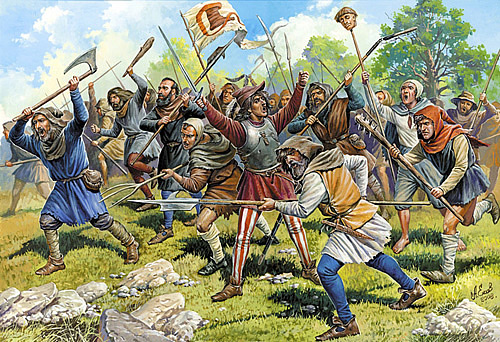
Luther's message became so strong that groups of peasants traslated the freedom of
faith to a freedom from social constraints.  Eventually this lead to a brief war that
resulted in the death of more than 100,000 rebel peasants.


Eventually, and again without prediction, Luther’s message gained so much power that it developed into a revolution among the peasants and resulted in a slaughter directed by Luther.  Luther attested that work was the primary duty on earth and thus equated the peasants to the devil and the Catholic Church.  Regardless of his intent, Luther had turned Europe into a religiously diverse territory and as the video said, became one of the greatest emancipators in history.  

Wednesday, September 2, 2015

Germany - Blog #2 - German Renaissance

I found a few things interesting in the Chapter 2 readings, one of which was the Imperial Diet at Augsburg in 1555 that established the beliefs of the empire as those of the ruler.  What I found intriguing about the German Renaissance in contrast to America today, is that it is similar to Christianity being the dominant religion in the United States.  Of course, here in the U.S., religion is left up to the individual and there is a defined separation between the church and state.  In today’s day in age, it would be considered entirely unacceptable if this scenario were to happen in America, but with the structure of our government and current beliefs within society, it is not something that could even be considered feasible.  In fact, you can see in recent years that the government appears to be separating itself even further from religious issues evident in the recent arguments about the use of “god” in the Pledge of Allegiance and by removing religion from other pieces of the government so as to not show a preference toward any one religion.  I found that the freedom to choose your religion by relocating under what the book defined as, ius emigrandi, to be obviously very different from what the norms are now in the western world for the obvious reason that people are granted the freedom to worship as they choose.  However, for this same reason, you could also argue that the two are very similar as the United States and many other countries, in granting the freedom to worship based on your own personal beliefs.

 Depicted here is the negotiations of the Peace of Augsburg which not only established the Lutheran states of the empire, but also allowed, ius emigrandi, or the ability to emigrate to another region that aligned with your religious beliefs.

At the same time that this was happening in Europe, the teachings of John Calvin and Calvinism were rather intriguing as it is similar to the battle that the United States is having in the Middle East.  Much of the conflict over there, and around the rest of the world through acts of terror, are being driven by religious beliefs and extremists who are jeopardizing the religious freedoms that others around the world are enjoying.  

John Calvin, teacher of Calvinism, proscribed that beliefs of the population should be personal and not those of the state.

A return of Calvinistic belief is what you expect to see in a country like the U.S. if a national religion were to be adopted as this country has been built on diversity over the past 50 years.  With the current social and religious standards in America, it would obviously be extreme if a group were to begin a civil war over religious beliefs within the borders of the United States, but that is easily assumed because of the demographic of the population and the ideals of freedom that the country has been built on.  People come to the United States as a way of escaping religious persecution or strife, so coming to the U.S. and causing conflict is not entirely likely.

Through the chapter reading, and through my own German heritage, it is evident to me that German’s have a strong belief system and a unified structure of dealing with important matters.   I find that this is also evident in Europe today in the European Union and their governing body.  Through Parliament, the EU uses a unified approach that is designed to be operated with all the member countries in mind, and while this has not been entirely successful recently with the downtown in the European markets, it is certainly the current trend in much of the world today with a concentration on equality.