I knew very little about Martin Luther prior to watching the
video, but wow, this man was the martyr that never was. In that, I mean that he did so many things that resisted the power of the Church in an effort to be the symbol of the common man. Here is a man that was so determined in his
beliefs that he knowingly faced what he expected to be a certain charge of
heresy resulting in death when he went to face the pope. In this “jury” he was given the
opportunity to recant all that he had written about the Catholic Church and
their contradictions, and he refused because he stood firm in his belief that he was right and that the Church was wrong. One
of the contradictions that Luther focused on was the practice of the 7
sacraments, which Luther insisted 5 of which were created by the Church as
only two existed in the Bible.
 |
| Martin Luther authored the 95 Theses, and as the story goes, attached it to door of the All Saints' Church in Wittenberg. |
Luther
was clearly a very strong-minded individual and played a role in Germany that proved
to be very pivotal in acting as a representation of the people of Germany and
their effort to stand up to the Roman Empire, the Catholic Church, and for the
freedoms as individuals to worship as they wish and not through the Church. This man, who authored the “95 Theses,”
started what would become the German Revolution, as well as playing a part in the Protestant
Reformation, and had a great impact on all of Europe and eventually the America which was founded on religious freedom.
At a time that the Church held such great power, it comes as no surprise
to me that the Church took his actions very seriously. After all, the Church and politics were
essentially the same body at this time, so to lose control in the church, meant
a loss of control in government and the empire.
Unknowingly to Luther, he had turned himself into a very
likable man by pointing out all the flaws in the Catholic Church and exposing the
use of the taxes that were funding the Roman Empire and the Church. Luther was a very wise and witty man with his
exploitations of the Church and refused to be slowed by the authority that it held. In a time when communication was obviously difficult,
Luther took advantage of the latest advances in technology by spreading his
beliefs through the use of the printing press and translating the bible into
German. The use of the printing press gave
the German-speaking population the opportunity to follow the word of god
through the bible and not through the message sent by the Church. It seems as
though his use of sarcasm and humor in his message played into the hearts of
Germans and other Europeans as it spread like wildfire.
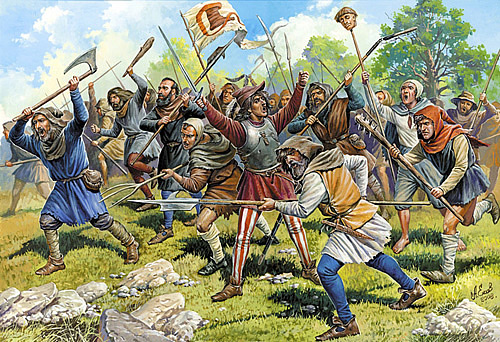 |
| Luther's message became so strong that groups of peasants traslated the freedom of faith to a freedom from social constraints. Eventually this lead to a brief war that resulted in the death of more than 100,000 rebel peasants. |
Eventually, and again without prediction, Luther’s
message gained so much power that it developed into a revolution among the
peasants and resulted in a slaughter directed by Luther. Luther attested that work was the
primary duty on earth and thus equated the peasants to the devil and the
Catholic Church. Regardless of his
intent, Luther had turned Europe into a religiously diverse territory and as
the video said, became one of the greatest emancipators in history.

No comments:
Post a Comment